Skip to content
Experiment

Lifebox

An experiment in whether an app's interface can be shaped for each person who uses it, instead of one design for everyone. It is planned as Atti's phone app.

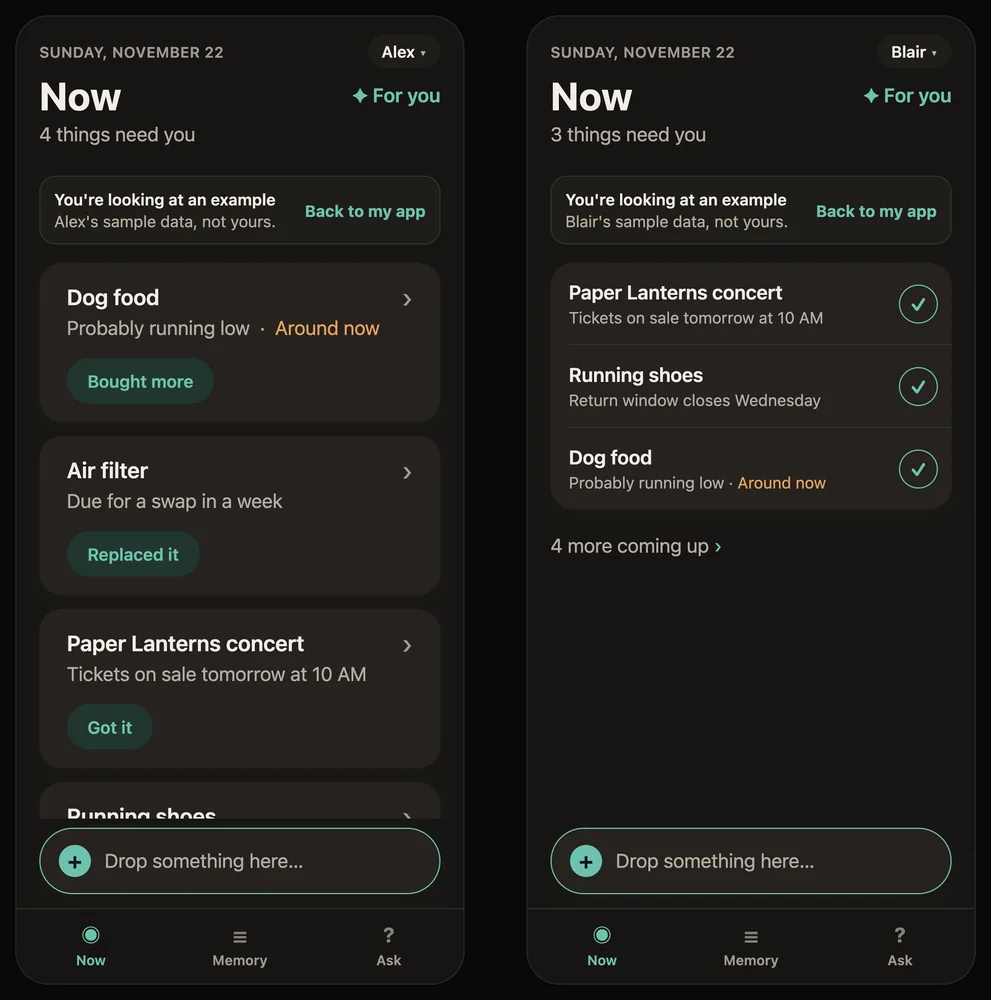
Lifebox's Now screen for Alex and Blair, the app's two sample people, side by side. Alex sees four things as large cards with action buttons, starting with dog food. Blair sees three compact rows with check circles, starting with concert tickets.
The same Now screen for two people: one app, assembled from each person's data.Working title in the app: Life Inbox.

The idea

Stable frame, adaptive content.

One codebase, with a different configuration for each person. The frame of the app stays stable and the content adapts: what shows on Now, in what order, and how dense it is.

What carries over from crowd testing: generate, constrain, measure, keep what works. What doesn't: the statistics.

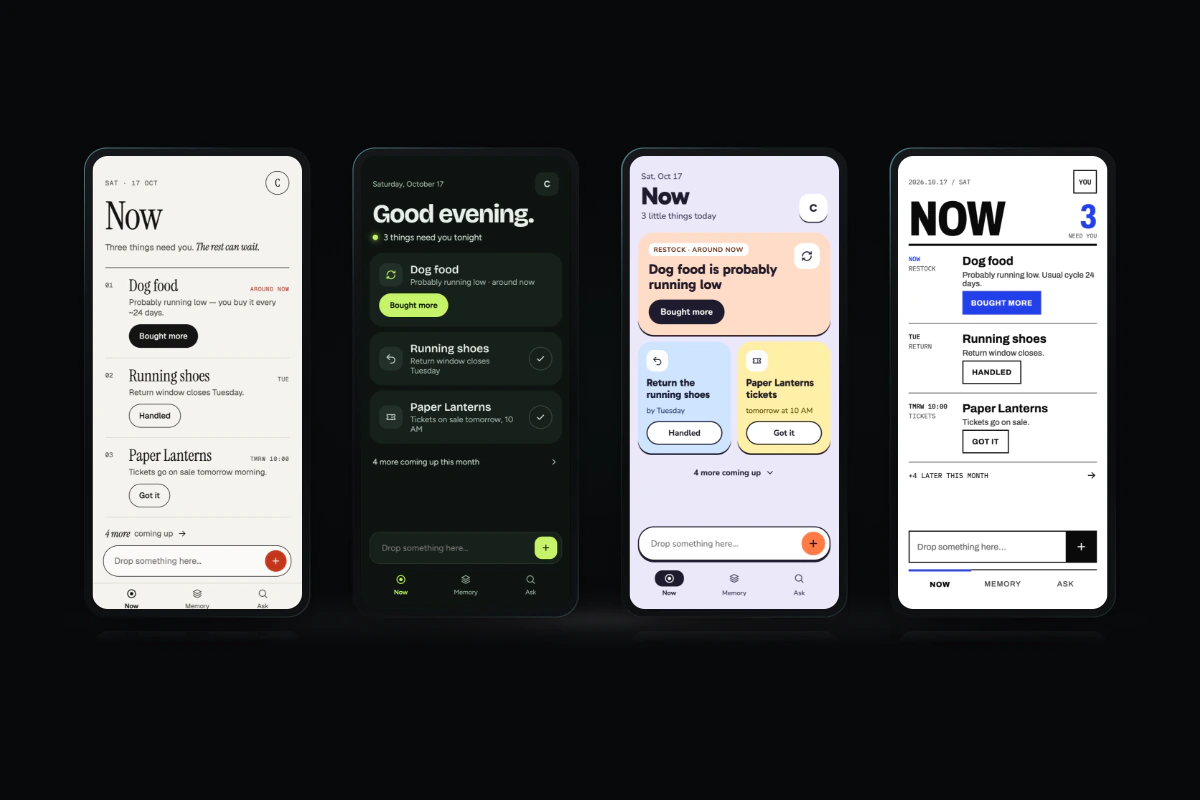
Four visual directions for the Lifebox Now screen, design mockups side by side.
Concept · four visual directions for the Now screen (working title Life Inbox), not the running app

Memory adapts too

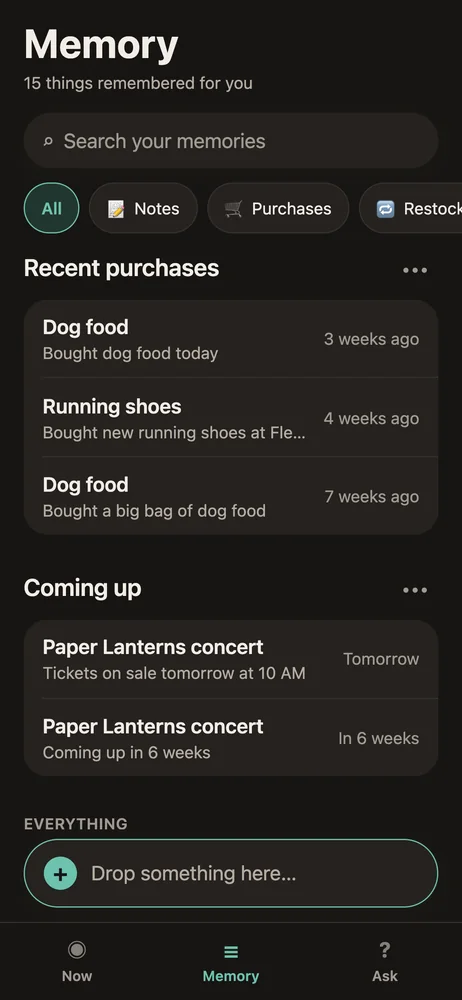
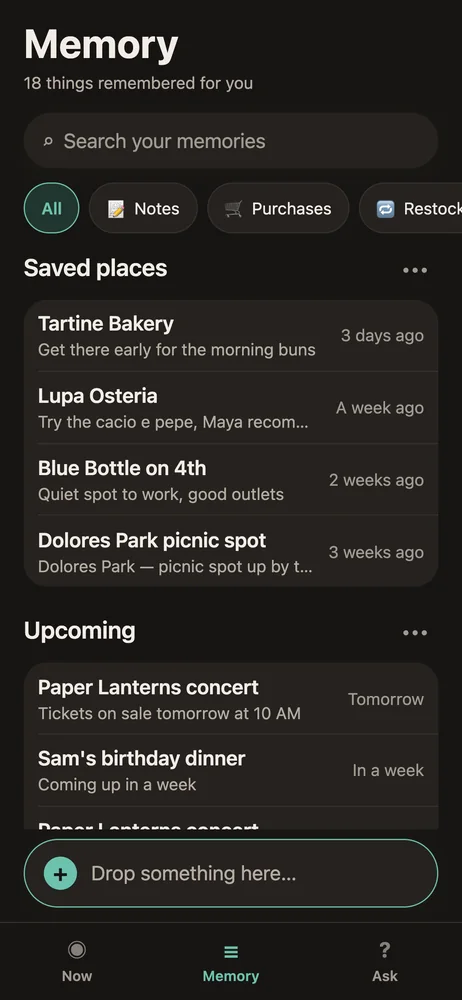
Alex's Memory opens on recent purchases. Blair's opens on saved places.

Both are the app's built-in sample people, running the same code.

Alex's Memory screen in Lifebox, sample data. It opens on Recent purchases: dog food and running shoes, then Coming up: a concert.
Alex
Blair's Memory screen in Lifebox, sample data. It opens on Saved places, such as a bakery and a coffee shop, then Upcoming: a concert and a birthday dinner.
Blair

Where it's at

An Expo and React Native app. You drop in short notes, and it turns them into structured memories and events, looks for patterns, and brings back what matters in a feed called Now. It is not released, and the hardest problem, shipping a different build to each person, is still open.

  • n = 1Each app is tuned for one person, so there is no crowd to average over.
  • 30–60 minOne iOS build and release, which this design needs per person.
  • 4visual directionsExplored for the Now screen.

Captain's log

From GitHub and the design notes
    • Studied how AI-run website testing compares with an app built for one person.
    • Planned as Atti's phone app.
    • The app notices what you log on your phone and offers a matching extra in For you.
    • Weekly summaries of themes, never notes, are sent only if you opt in.

Not yet grown

  • A release per user, Not yet grownQuestion
  • Atti proposes changes, Not yet grownIdea
  • Personal to core defaults, Not yet grownIdea
  1. Personal
  2. Popular
  3. Community
  4. Core

When a personal change keeps winning for several people who opted in, it could become a candidate default, climbing from personal to popular to community to core. An idea, not built.

Go deeper

Grow your own app

You tell the app what you want in your own words. When the change fits the layout settings it already has, it makes it right away and keeps an Undo. Anything else can be sent on as an idea for a later build.

  1. Step 1
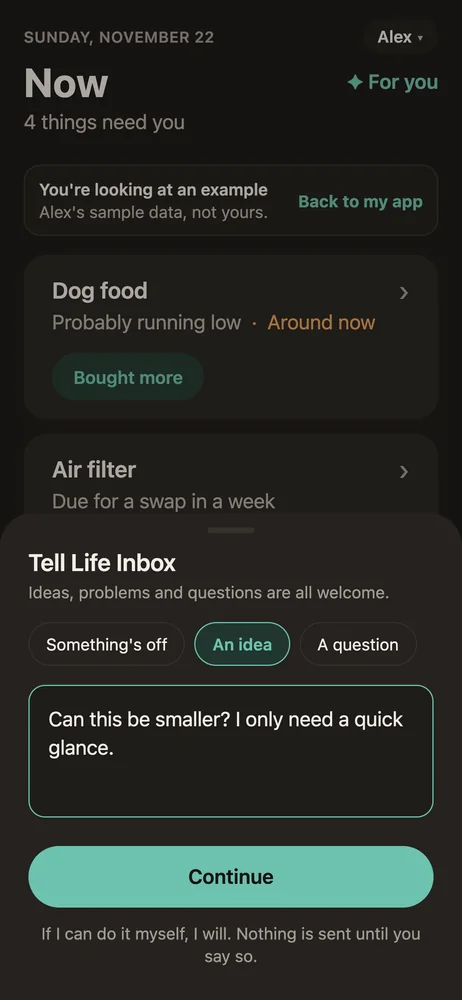
    The Tell Life Inbox sheet in Lifebox, with An idea selected and the request: Can this be smaller? I only need a quick glance.

    Alex asks in plain words: "Can this be smaller? I only need a quick glance."

  2. Step 2
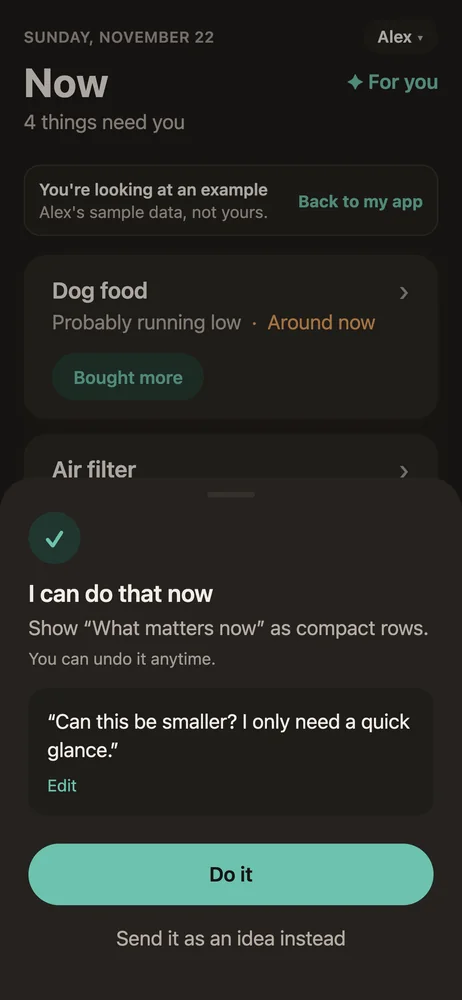
    Lifebox answers I can do that now: show What matters now as compact rows, undo it anytime. A Do it button sits above Send it as an idea instead.

    The app can make this change itself, so it offers to do it now.

  3. Step 3
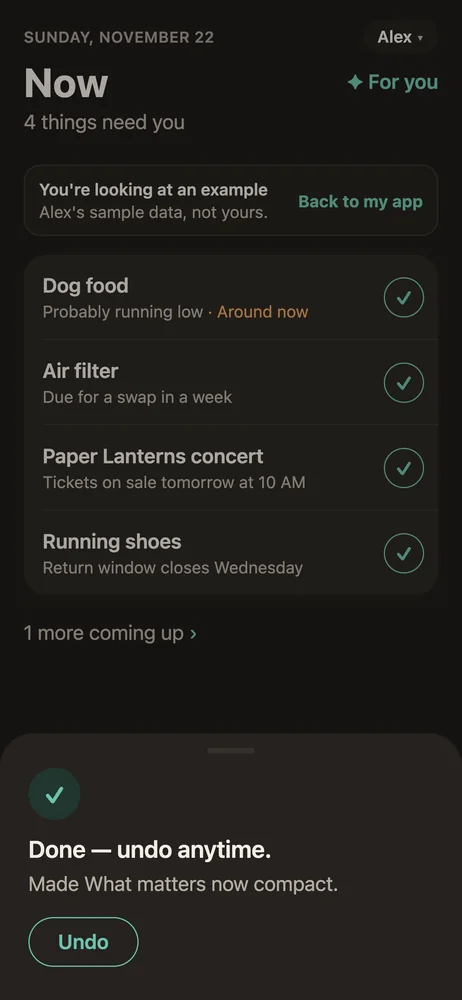
    Alex's Now screen after the change: the same four items as compact rows with check circles, and a sheet that says Done, undo anytime, with an Undo button.

    Now switches to compact rows, and Undo stays one tap away.

  1. A crowd, or one person

    How AI-run website testing compares with an app built for one person. The loop carries over; the statistics don't.

    Research note · adaptive interfaces

  2. Planned as Atti's phone app

    Capture goes in, and a Now feed of open tasks comes out.

    Doc · Atti plan, personal brain

  3. Stable Frame, Adaptive Content

    A design paper, draft 2: what may adapt, and how to test a change when the sample is one person.

    Doc · design paper, draft 2

Next project

Duo Decide
Back to PAS